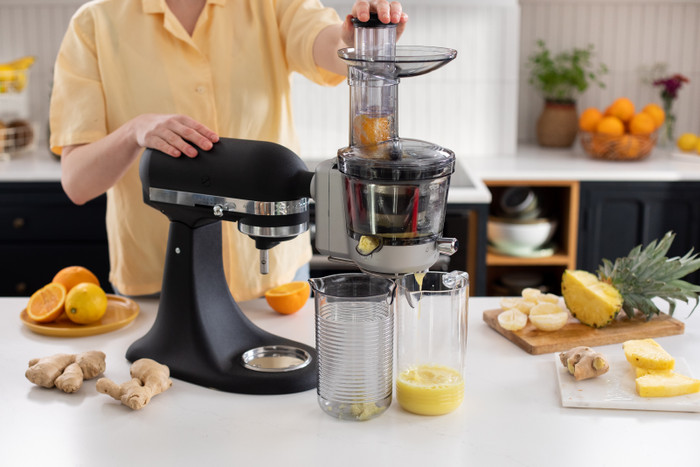
This slow juicer does exactly what you want it to do; slowly grinds, cuts and squeezes all the fruit and vegetables you put into it into a juice. The quite dry pulp comes out neatly on the other side of the device. The fact that the pulp is very dry indicates that little juice is lost during the process.
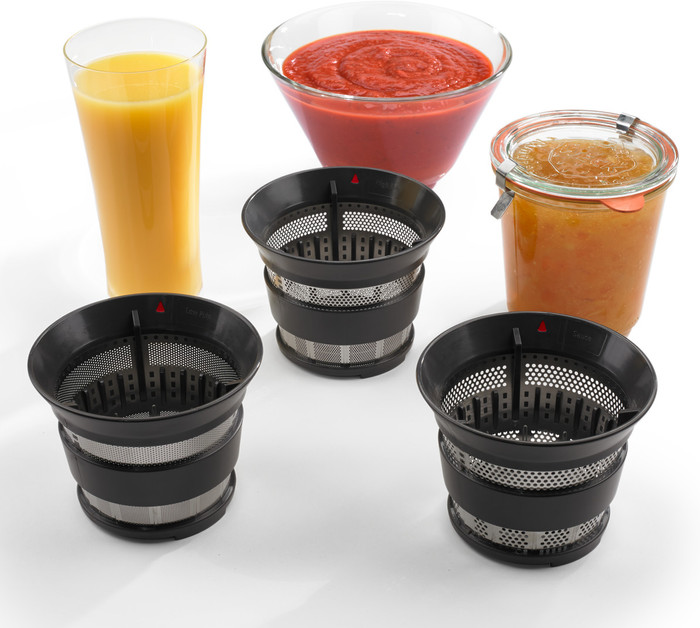
This slowjuicer does more than just slowjuicing. For slow juicing, use the sieve that completely separates the pulp from the juice. Two extra sieves open up more possibilities. One of the additional sieves allows a small portion of the fine pulp to pass through. By using this sieve you can make smoothies or prepare soups (exit immersion blender and soup splashing around). The second extra sieve allows some more pulp to pass through. With the use of this sieve, sauces or jams can be made. With all its possibilities, this slow juicer is a device that goes far beyond the name slow juicer.
I had my doubts about the construction: a heavy appliance for the kitchenaid. Wouldn't that swing a lot? Kitchenaid also lives up to its name here. During the slow juicing process, the entire construction remains stable. In fact; the structure itself barely moves.
The slow juicer consists of many parts. Putting it all together for the first time is almost a mathematical puzzle. Once you've seen how it's done once, it's so simple and logical that the manual can be omitted the second time.
Just be careful when putting on the lid; it must be turned by force through the safety lock. If you don't do this, the device will not start because the security is not enabled. It is impossible to touch the blades with your fingers while turning. This makes the device very safe to use. The safe disassembly of the used device can also be done safely.
Well, and then cleaning it after use... As far as I understand, that is a challenge and a job with every slow juicer. The fact that the first part you encounter when unpacking the kitchenaid slow juicer is a kind of toothbrush does not bode well. In practice: the slow juicer can be taken very far apart, so that not many awkward corners with pulp residues remain. Rinsing the pulp residue under the tap takes some time, but is not difficult. The majority of the slow juicer can be pulp-free in this way. The sieves are an exception. In order to get all pulp residues away from here, the "toothbrush" is really needed. When everything has been rinsed, the parts can be washed or put in the dishwasher. There are no parts that are not dishwasher safe.
The juice flow can be shut off with a tap. My experience is that this tap cannot be closed completely. A few drops do come out. If you want to keep your countertop clean, it is useful to put a glass or the like under it.
Included with the slow juicer are two jugs for during use. These fit together so take up little space when storing. One of the two jugs can be closed with the supplied lid.
Also included is a storage system for the different sieves. Kitchenaid thinks carefully about ease of use, which is again clear here.
People who are looking for a slow juicer but don't have a kitchen aid food processor at home are really out of luck. This slow juicer is so much more than a slow juicer.
Do you have a kitchen aid at home; then look no further at other slow juicers. The purchase price of this slow juicer is more than compensated for by the extra options and the ease of use that this slow juicer offers!