Rode VideoMic Rycote
Never available again
View alternatives in the sidebar
View alternatives in the sidebar
Application microphone | Filming with SLR/CSC, [ENG], [Location] | |
|---|---|---|
Microphone model | Shotgun microphone | |
Directional characteristic | Supercardioid | |
Type of microphone connection | 3.5mm jack | |
Microphone sensitivity | -38 dB |
According to our camera microphone expert
De Rode VideoMic Rycote maakt gebruik van een 9V-batterij, die 100 uur mee gaat.
De microfoon heeft een frequentiebereik van 40Hz - 20.000 Hz.
De microfoon komt niet in het beeld van de camera, bijvoorbeeld bij het gebruik van een groothoeklens.
De kwaliteit is goed, maar het is geen XLR-microfoon. Zorg dus goed voor de kabel van de Rode VideoMic Rycote.
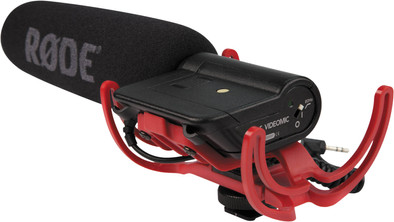
The mounting system of the Rode VideoMic Rycote insulates the microphone from contact or control noises completely. It's made of wear-resistant plastic itself. The super-cardioid microphone is connected to the camera via a standard stereo mini jack output. The high pass filter of 80Hz lets through high-frequency sounds, but eliminates low-frequency sounds such as the hum of heavy machinery and passing traffic.
Note: the camera in the photos isn't included5 stars
14
4 stars
39
3 stars
2
2 stars
0
1 star
0
Sound quality
User friendliness
Design
Options
Introduction & Delivery. I had been looking for a good microphone for my movies for a long time, but I didn't want to pay the top price (think of the NTG-2 for example). After looking around a lot on the internet I decided to buy this microphone. I had seen many good reviews. The delivery was very good and fast by CoolBlue and I also got a free DeadCat (definitely recommended)!
The box. The product came in a solid nice box with the microphone (with wind cover) and the manual packed inside, however a battery is missing. (Luckily I had a 9v lying around). The mic looks solid and Rycote's shock mount won't break/crack easily. However, the microphone is quite large, this could be a reason to buy the RØDE Videomic Pro instead of this microphone. The microphone also has a coldshoe mount at the bottom and a 3/8" thread hole. I would have preferred a 1/4" here, so it could be mounted on my boompole without an adapter (not from RØDE itself, the RØDE boompoles do have a 3/8" connection). I immediately took advantage of the 10 year(!) warranty that RØDE offers when you register the product online.
The product. The product itself has two functions, a "normal" function and a high-pass filter, the high-pass filter filters out any bass from the sound. Think, for example, of noise and traffic. Works very well! I do have noise in my recording, but this is due to the cheap pre-amp in my SLR (550D), it is highly recommended to buy a separate recorder if you buy this microphone for your SLR! (However, takes a lot of time in post and will therefore not be suitable for fun holiday films and other films that will only play on your own TV). Also handy is that there is a light on which you can see if the battery is low (red) or not (green), this is not on some other microphones and can be very frustrating if your microphone was empty half the recording day and you everything has to go ADR (dubbing). An average 9V battery lasts about 100 hours. The microphone also has a -10 and -20dB function, this is for events, performances and other events where a lot of sound is released. However, these sliders are behind the battery and are TERRIBLE. You'll need something like a small screwdriver or pin if you want to use this feature at all. I don't use it and haven't tested it (yet), so I can't say anything else about this function. The microphone is a shotgun microphone and is therefore especially sensitive at the front. The cable feels strong and will not break too quickly, you don't want that either, because the cable is not easy to replace. The sound is not very strong and it is also advisable to get the microphone as close to the actor (or: the person speaking) as possible (with a boompole for example). I use this microphone with a DeadCat (as mentioned before) and sometimes hairs appear in the image when I put the microphone on the camera itself, this is easy to fix, but if you don't realize it quite deadly for your shot.
Usage. I use this microphone for a short film on a boompole. It's a good directional microphone. I have now used it in one shooting day (and some tests before that, of course) and the microphone works perfectly. By the way, a little tip, NEVER forget to turn on the mic before shooting (or don't let your sound guy forget this), this has caused a few problems on set with me (sigh).
Conclusion. A very solid microphone with a good price-quality ratio. The design is nice, but a bit big. The microphone has good directional sensitivity and the high-pass filter is a big plus. However, the -10dB and -20dB switches are a minus, but what would you complain, for that price?
Martijn
23 July 2014
Automatically translated from Dutch
Rode Videomic rycote is a nice addition to the DSLR camera for people who want to record videos and sound. Rode Videomic rycote has a shotgun shape, meaning it faces forward. It records sound very well and can therefore also be used for recording concerts or motorsports. You could even run with the Rode Videomic rycote on your DSLR camera without hearing the mic shake or the wind.
tip: don't forget to turn off the Rode Videomic rycote when you are done using it (you will save on the 9V BATTERY)
denzyl Martina
27 June 2013
Automatically translated from Dutch
Summary: All in all, I've spent quite a few hours with the Videomic Rycote and it's a faithful extension of my camera. The advantages of this microphone with the long battery life, good sound quality and low price outweigh the bad Deadcat and the fragile cable. This microphone completes my recordings, although don't forget to turn it on!
Full review: I have been working faithfully with my Canon 60D SLR camera for years. Unfortunately, the sound quality of the internal microphone was no longer suitable for me to film professional interviews. Because I work a lot in dynamic areas and always have the camera in my hand, I was looking for a microphone with a naturally good quality and a long battery life.
Partly because the Rode Videomic GO does not have its own battery and is therefore powered by the camera itself, and because I found the Videomic Pro a bit too expensive, the Videomic Rycote was the ideal match for me.
And as I am used to from Coolblue, the microphone came to my front door at the speed of sound, of course carefully packaged and delivered with a smile by the postman.
The microphone itself is nicely displayed in its packaging and the necessary cable was well protected in the box. The booklets and warranty cards were neatly packaged and were clear and easy to read. It was nice to see the personal control note with all the contents of the packaging checked off and signed by an employee of Rode, something that gives a nice personal touch to the whole. By the way, don't forget to register the camera on the Rode site, which ensures that you get a 10-year warranty on the product.
The microphone itself has a stylish design. The “Lyre” suspension system is very flexible and ensures that small movements are absorbed and the sound is not affected. Sometimes the system may work a little too smoothly and the microphone wobbles quite a bit while walking. The 25 cm long shotgun initially looks large, and also has the disadvantage that it is deeper than its brother and sister due to the external battery, but the microphone never comes into view (not even with a 17 mm wide-angle lens). Fortunately, the center of gravity is well-balanced and the microphone weighs only 180 grams, which is handy for filming by hand.
The cable is curled up, which ensures that it cannot accidentally sit in front of the lens, for example. It is a pity that the cable is stuck deep into the microphone and therefore cannot be replaced. So watch out and be careful with the cable. However, Rode has already taken precautions by clamping the cable partly around the battery housing so that there is still a little slack if it is pulled hard.
The mounting on the hot shoe is sturdy but sometimes difficult to tighten or loosen because the suspension system is a bit in the way, but will fortunately not slide off its place with proper use.
After I have unpacked everything and also managed to find a 9V battery (unfortunately it was not included), the Videomic is ready for use. Furthermore, I have no doubts about the economical battery use: I have filmed less than 100 hours, but the battery is not immediately empty if you accidentally leave it on after use. Unfortunately, the wind filter does not do its job optimally, which will also be the reason why Rode sells a separate Deadcat. In my opinion, the supplied windshield is therefore more for protecting the capacitor than keeping the wind noise out of the recordings. Something I think is a shame because I often make my videos outside and it is not exactly windless in the Netherlands. Yet this problem can be circumvented: namely through the High Pass filter, which does not absorb sound below 80 Hz. This mode can be activated by sliding the on/off switch on the back up to 80 Hz. Initially a nice extra, but unfortunately the option does not work optimally with my camera because the different software does not support each other well. A solution for this is to control the sound on the camera completely manually. Only then can the microphone with High Pass filter come into its own.
After my first day on the field was over, I started up the post-processing software and was happily amazed at the sound quality. The sound was clear and free from ambient noise. This while the microphone was soon more than 50 cm away from the speaker. I've heard references to the Videomic Pro, and yet I find the difference barely noticeable in everyday use.
One feature of the microphone that I have not yet used is the physical sensitivity settings. The buttons for 0, -10 and -20 dB are only accessible via the battery cover and then the battery itself must also be removed. Fortunately, I can set the sensitivity in my camera myself and it is not necessary for me to adjust anything here.
It is clear that this is a real camera microphone, but I find it very unfortunate that the microphone offers poor support on a computer. I couldn't get it to work on Windows 7, 8 and 10, not even with an external USB sound card. The computer connection can detect the microphone, but the sound volume that the microphone transmits is simply too low. This is because a computer has a “high-level” input and is therefore not suitable for the “lower-level” output of the microphone. I didn't buy the microphone for my computer at first either, but it's a shame I can't use it for my Skype calls.
Nevertheless, despite these minor flaws, I am very happy and the Rode Videomic Rycote shines on top of my camera every week like no other. A fantastic purchase that will last for years to come!
Jeroen Breedveld
16 August 2015
Automatically translated from Dutch
Product number | 329460 | |
|---|---|---|
Manufacturer code | RD103287 | |
Brand | Rode Microphones | |
Warranty | 2 years | |
Processing of your defect | Via Coolblue |
Microphone model | Shotgun microphone | |
|---|---|---|
Directional characteristic | Supercardioid | |
Transducer | Condenser | |
Microphone suitable for | Mirrorless camera, Single-lens reflex camera | |
Zoom microphone | ||
Microphone recording type | Mono |
Frequency range | 40 - 20000 Hz | |
|---|---|---|
Signal-to-noise ratio | 74 dB | |
Impedance | 200 O | |
Microphone sensitivity | -38 dB | |
Maximum SPL | 134 dB |
Type of microphone connection | 3.5mm jack |
|---|
Width | 10,2 cm | |
|---|---|---|
Depth | 25 cm | |
Height | 6,5 cm | |
Weight | 0,176 kg |
Power supply type | Rechargeable battery | |
|---|---|---|
Type of battery | Standard batteries |
Receive more coverage in case of damage than with your standard warranty. Coolblue takes care of everything: from taking out the insurance to repairs. Is a repair not possible? You receive the purchase price as CoolblueCredit.
XCover is allowed to arrange and process insurances on behalf of the insurer. The insurances are governed by Belgium law. If you have a complaint, you can contact the or our customer service.
First, add your camera microphone to your shopping cart. On the next page, choose the Protection Plan below. You always have a 30-day return window and pay no deductible in case of damage.
The insurance can be canceled every year, even if you have paid in advance. If you cancel earlier, you will receive a refund for the overpaid amount.