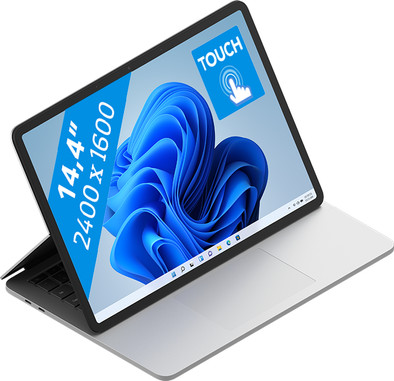
After having enjoyed using the Surface Book 2 (i7 8650U/8GB/GTX1050) for 3.5 years, I was looking for a successor. I ended up with the Surface Laptop Studio (i5 11300H/16GB/Iris Xe) for almost the same price as the SB2 at the time. Because I can imagine that the potential buyers have had a Surface Book before, I compared it with that as much as possible.
The SLS is the successor to the Surface Book line. In terms of size, they are actually the same and the weight of the SLS is slightly higher (1754g) compared to the SB2 (1622g). I expected a lighter weight and thinner design, given the special mounting mechanism in the SB2. The charger of the SLS is slightly smaller and lighter.
The special screen mechanism will play an important role in the purchase consideration of both. The SLS can still be used as a tablet, but no longer separate from the keyboard. That is immediately a major disadvantage: you then drag the entire laptop (SLS 1754g) instead of just a tablet (SB2 710g).
However, there is now the option to position the screen in front of the touchpad, which is useful, for example, when viewing videos and photos. The screen of the SB2 was not bad, but the SLS surpasses it with nicer colors, smoother due to the higher number of Hz and can be a bit brighter. The reflection is still the same.
To compare performance I ran both with a clean Windows 11 installation. In terms of processor, they are very comparable with 4 cores and 8 threads. However, the Cinemark benchmark shows the progress, with 43~93% higher performance: SB2 single 960 / multi 2890 | SLS single 1373 / multi 5590.
You will not notice this immediately during normal use. For example, startup is just as fast and no immediate differences are noticeable when browsing. In terms of gaming I have tried Age of Empires IV (from Microsoft), I see the same settings there as well (low-medium at 1920x1080px). A nice improvement, because the i5 8650U can keep up with the separate NVIDIA GTX 1050 video card of the SB2 with less heat, noise and energy consumption. But do not expect high gaming performance from the i5 variant, for that you really have to look at the i7 variant with separate NVIDIA video card.
Apart from that, there are a few other advantages: the much better sound system with a bit of bass (for a notebook). The slightly more pleasant touchpad. And the webcam gives a nicer picture, but with slightly less detail. There are also other drawbacks: the number of connections is (too) limited with 2 USB-C, there is no longer an SD card slot or USB-A input. The special pen for, among other things, the tablet position is unfortunately not included, despite the high price.